| Cortona,
Italy
is a Tuscan town of Etruscan origin that spreads up the
steep slopes of a hill rising from the
Val
di Chiana.
Indeed, it was one of the
Etruscan Dodecapoli (league of twelve cities).
Cortona is surrounded by defensive walls, the foundations of which date back to the Etruscan
period and are easily recognised as such by their "cyclopian"
construction, so different from the regular rows of large squared blocks laid
down in Roman times and smaller ones from the mediaeval period. Tightly-clustered
mediaeval houses pack the slopes, leading upwards to an open green area
in the middle of which is the huge Medici fortress (the Fortezza
Medicea). The road to Cortona from the valley starts near the Melone Etruscan
tombs. On the way up the hill
the road passes more Etruscan tombs, olive groves and the Renaissance Church of Santa Maria delle Grazie al
Calcinaio. Those arriving by bus alight in Piazza Garibaldi from
which there is a splendid view out over the
Valdichiana. From the square,
visitors walk along Via Nazionale, Cortona's only horizontal street, to
the Piazza Repubblica and the Piazza Signorelli which form the centre of
Cortona, Italy.
Click
for further Cortona,
Italy, Tourist Information
|
|

Aerial
view of the centre of Cortona, Italy
Accommodations
in Cortona, Italy

Tanella
o Grotta di Pitagora - the "Tomb of Pythagoras"
| The
so-called Cave, Den or Grotto of Pythagoras is one of the more famous
of the Etruscan tombs on the outskirts of Cortona, Italy. (It has no connection
with Pythagoras.) It dates from the fourth century B.C. and was already known in the 1500's and
when it was visited by Vasari. The earth tumulus that covered the tomb
is long gone, leaving an arched structure and the cruciform tomb chamber
which measures 2 m by 2.5 m and was enclosed by large wedge-shaped blocks.
The approach is along an avenue of cypresses which adds to the pleasing ambience
of the location.
|
|

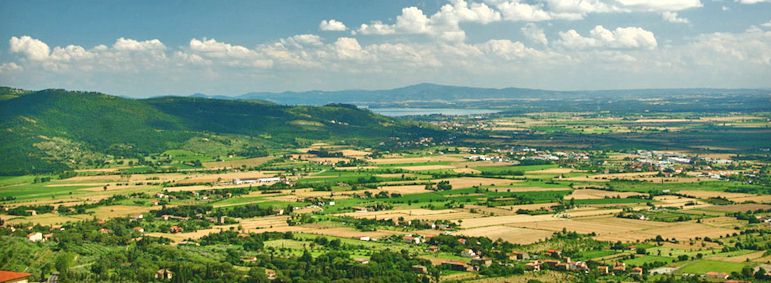
View
of the Valdichiana and Lake Trasimeno from Piazza Garibaldi, Cortona, Italy
| Cortona
is justly famous for its panoramic views out over the
Val di Chiana
with Lake
Trasimeno
in the distance. In fact, the views are one of the reasons to make the
climb up to the Fortezza
Medicea at the summit of the spur on which Cortona is located. The present-day appearance of the Val di Chiana is
the result of marsh drainage and reclamation work that was started by the Romans and carried on right through to the 20
C, although drainage of the malarial wetlands was largely completed by
1840. Leonardo da Vinci drew a map of the area at the beginning of the 16 C, that shows the valley occupied by a large lake running north-south.
It is now a verdant plain extending all the way to Lake Trasimeno.
|
|

Cortona,
Italy - monthly antiques and flea market
Cortona
offers an excellent monthly antiques and collectables fair and an annual
antiques exhibition. The monthly antiques and bric-a-brac market
takes place on the third Sunday of the month in Piazza Signorelli.
The
Cortonantiquaria, the Cortona Antiques Exhibition, is held annually
in the 18 C salons of the Palazzo Vagnotti and the Palazzo Casali from the
last Saturday in August to the second Sunday in September. This is one of Tuscany's biggest antiques fairs, attracting around 50 exhibitors from all over Italy.
It was initiated in 1963 to promote Cortona’s flourishing restoration and furniture reproduction
business. The Cortonantiquaria was primarily dedicated to the “mobile
antico” (antique furniture) but over the years it has been enlarged to include art, jewellery and other antiques.
The
Cortonantiquaria
in 2010 takes place 28 Aug 2010 to 12 Sept 2010.
A
huge antiques fair is held on the first Sunday of the month and the
preceding Saturday in nearby Arezzo.
Over 500 dealers usually show up offering a vast range of collectables
for sale. This is probably the largest fair of its kind in Italy.
|
|
Cortona
Italy
© ammonet
InfoTech
2009 - 2012. All rights reserved.
Web
hosting, web design, database development by ammonet